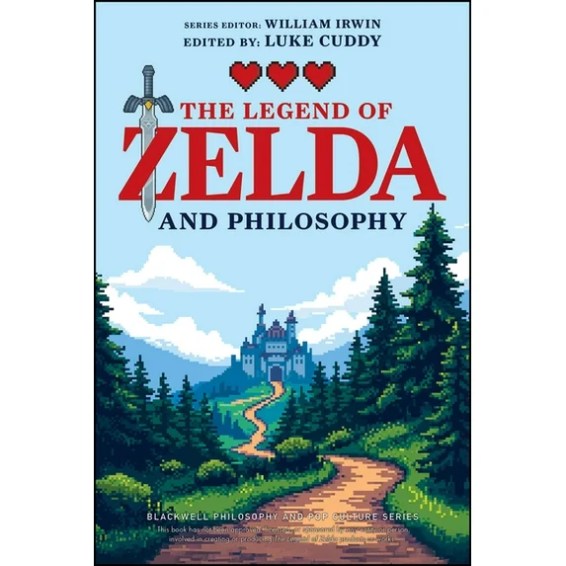
The newest entry in the Blackwell Philosophy and Pop Cultures Series, The Legend of Zelda and Philosophy does pretty much exactly what you’d expect. It explains broader philosophical ideas from the perspective of the Legend of Zelda games. But don’t let the fact that this book comes from an academic publisher fool you. This is a surprisingly accessible tome of Zelda lore, where the vast majority of references either directly cite well-known works of the greater philosophical canon, the games themselves, or secondhand materials like interviews. The notes sections alone might be worth the price of purchase for a dedicated fan, as they point to some fairly obscure interviews with game creators like Shigeru Miyamato.
The book is divided into five themes. The first one, Community and Beauty, has essays discussing the social world of Hyrule. The standout, Majora’s Mask and the Carnivalesque by Siobhan Lyons, frames this classic game according to Mikhail Bakhtin’s philosophy of the carnivalesque, and how the game depicts a world where the rules are overruled and suspended in this tradition. Majora’s Mask has become a classic of the Zelda series in part because of its distinct grotesqueness, and it’s a pleasure watching Lyons exposit the inherently social nature of the game.
But the games are not Link’s journey alone. They’re also the path we trod as players. In the final closing section, Take Any Road You Want discusses how these are fundamentally stories of choice. Perhaps unsurprisingly, in this section and others, there’s a significant emphasis on Breath of the Wild and Tears of the Kingdom, neither of which is a retro game even if Breath of the Wild is coming up on its nine year anniversary. Nevertheless, Casey Rentmeester does have a compelling discussion of the idea of “flow” in Intermittent Flow in Hyrule, that explicitly the first two games in terms of the epic scale of mapmaking required.
In the second part, Lenses of Truth, editor Luke Cuddy tackles mapmaking directly with The Legend of the Zelda Map: A Look at Truth and Reality. This is the most abstract collection of essays in the set, and Cuddy’s in particular discusses how the very concept of maps are impositions on the environment. Ironically, I liked these essays the least precisely because they didn’t seem to go quite far enough with their existential analysis. Zelda randomizers, for example, add an entirely new dimension to questions like whether or not the hookshot can really be in the Desert Palace.
The third part, Playing with Din’s Fire: Ethics and Virtue, deals with more straightforward moral conflicts. Kyle York, for example discusses whether we should just leave the bokoblins alone, given how much they seem to be minding their own business. These are the questions that prompt pacifist runs of video games. How much free will we can even have in a Zelda game or any other, well, that’s the question broached in the part four essays, unified around the theme of I Am Error: Meaning, Freedom, and Destiny.
When Kiki Berk asks where Link’s life is meaningful, the implicit subtext is to also ask whether our own lives are meaningful. There’s no denying that countless people have been enriched by the Legend of Zelda games. Where this collection excels isn’t by extolling the particular virtues of this franchise, but by helping to bridge the gap and show just what is it about these games that’s so oddly relatable, how even in the eight-bit era, there are all sorts of ways we can interpret them. But most of all this book is remarkably accessible. I can easily see it opening a Zelda-loving teenager’s world.

The post A review of The Legend of Zelda and Philosophy appeared first on Old School Gamer Magazine.
From:
Old School Gamer Magazine