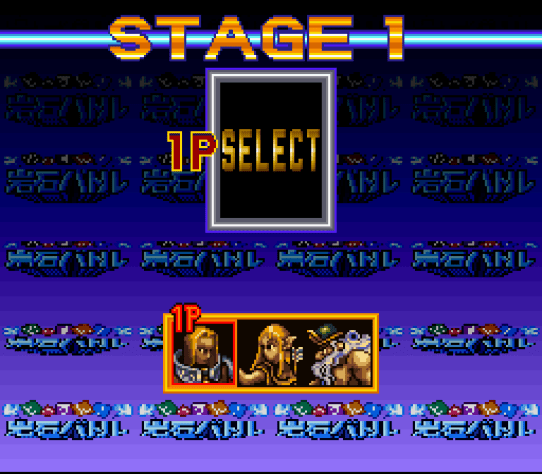
For almost as long as there have been puzzle games, there have been puzzle fighters. The two-player version of games like Tetris and Puyo Puyo generally work by having garbage pieces added to the other player’s screen whenever one player clears a lot of the board. Where Dossun! Ganseki Battle breaks the format is that this is a puzzle game which can only be played competitively. There’s no score, only a life bar. What’s more, instead of pieces being generic, they do specific actions upon being completed. A healing potion restores health, for example, while a sword stabs the opponent.

The relative obscurity of Dossun! Ganseki Battle is most likely due to the fact that despite being the first dedicated puzzle fighter, the game masquerades itself as a JRPG with its design. There’s quite a bit of text, absolutely none of which is required to actually play the game. Hints like whether the next opponent is strong or weak against magic aren’t all that helpful given that, as anyone who’s ever played a puzzle game knows, you generally try to just clear whatever you can without regard to what color the blocks are. Special moves, whether used by the player or the computer, are helpful mainly because they give you a few seconds to look at the frozen board during the cutscene and better judge your next move.

There are two English translations now. The Aeon Genesis version from 2000, and a Stoneboat version that came out last month which also includes a Vietnamese language option. It’s not clear whether Stoneboat was aware that the Aeon Genesis version existed. I certainly didn’t, as it’s not one of their best projects. Frankly speaking, it’s a little rough compared to the Stoneboat script, although really, there’s only so much you can do with a simple cheesy script that only provides some light fantasy context as to who the next monster is that you’re going to fight. The main thing the translation makes clear is that you get better endings on higher difficulty levels, although the main reward is the satisfaction of taking down nine opponents in a row with only three continues.

There’s more luck involved with Dossun! Stone Battle than in the typical puzzle game, or even puzzle fighter, mainly because whether you win is often a function of how lucky the computer player gets with their board. There are two ways to lose, either by overflow or by losing all your life. While the player will almost always lose by overflow, the computer player usually loses by having their life depleted. The computer player can’t generally compensate for garbage blocks in bad positions and has to use special moves to deal with them, although it’s easy to beat even the final boss quickly if you can get enough garbage blocks in bad positions quickly enough on him.

That’s something a player can only really learn how to do with a lot of practice though. A newbie will more likely than not be frustrated by elixirs. As in normal JRPGs, elixirs bring you to full health. There are only three elixir blocks per match, and they effectively become garbage if the player places them in such a way they can’t line up three in a row. Whether the computer player lines them up in such a way is a big deal, since if they do, there’s an excellent chance they’ll get a full health refill before the match is up, effectively forcing the player to restart from scratch except at a higher speed.

Even at the time of its original release, Dossun! Ganseki Battle was a niche idea. Paradoxically, puzzle games have generally gotten simpler, rather than more complicated, over time, so it’s a bit of an odd vibe for Dossun! Ganseki Battle to feel like such an antique mainly because the game expects the player to figure out how the game works for themselves. It’s probably destined to be forgotten again, although anyone who’s a fan of the puzzle fighter genre will find it well worth the effort to take a look at what might have been.

The post Looking Back at Dossun! Ganseki Battle appeared first on Old School Gamer Magazine.
From:
Old School Gamer Magazine